Explore our products or discuss your specifications with the JEXMOO team. We work with businesses to bring custom designs and manufacturing projects to life.
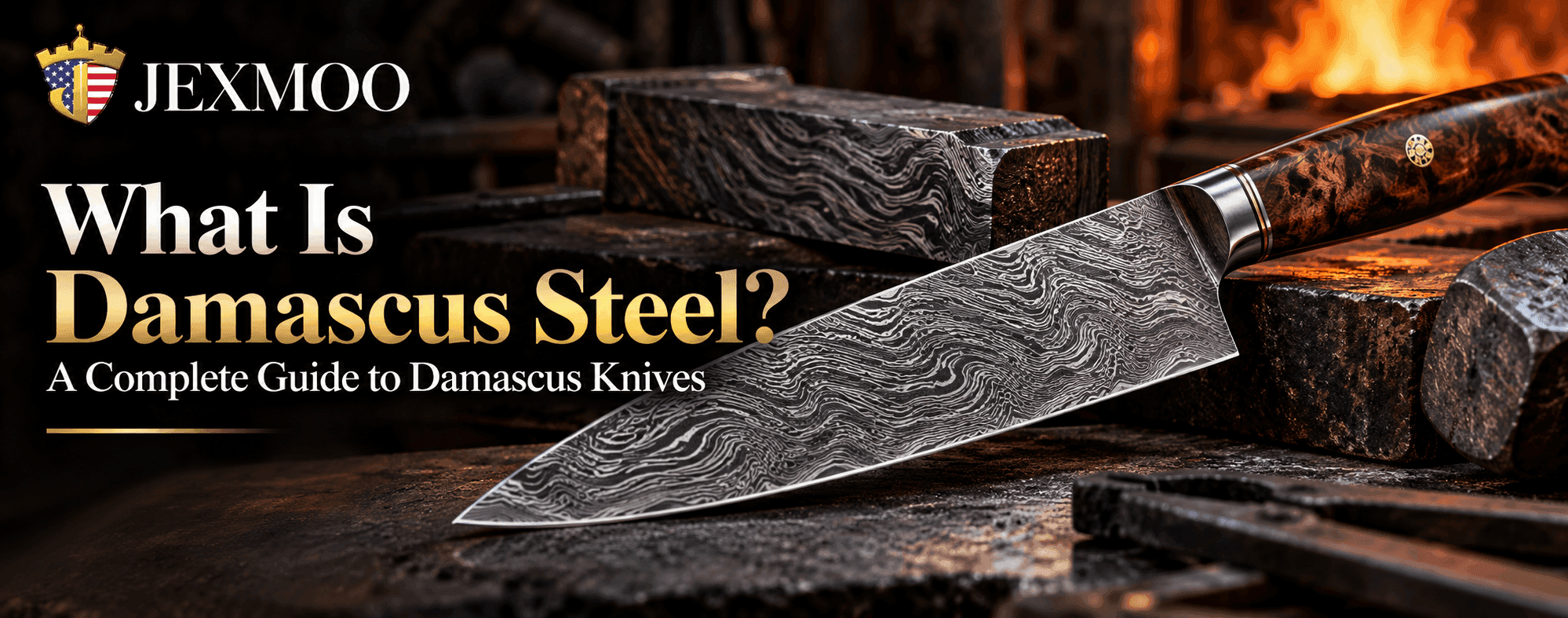
What Is Damascus Steel? A Complete Guide to Damascus Knives
What is Damascus steel, and what makes Damascus knives distinctive? Discover the history, manufacturing process, steel properties, performance factors, and care requirements behind these patterned blades in this practical, evidence-based guide.
JE
Jexmoo Enterprises
JEXMOO Enterprises
Damascus steel is known for its distinctive flowing patterns, contrasting lines, and craftsmanship. Found in everything from kitchen knives to hunting knives and collectible blades, it combines visual character with the practical requirements of a working cutting tool.
But what exactly is Damascus steel? Is it stronger than ordinary steel? Does its distinctive pattern improve sharpness or edge retention? And what should buyers know before choosing a Damascus knife?
The answers depend on how the steel is made, which materials are used, and how the finished blade is heat-treated and shaped. The patterned appearance is only one part of the story.
This guide explains the history of Damascus steel, the manufacturing process behind modern Damascus knives, their potential benefits and limitations, and the maintenance practices that help keep them in good condition.
What Is Damascus Steel?
Damascus steel is a term commonly used for steel with distinctive patterns resembling flowing water, wood grain, waves, or ripples. In modern knife manufacturing, the term most often describes pattern-welded steel, although other patterned and specialized steel constructions also exist.
Pattern-welded Damascus is generally made by joining different steel alloys into a composite billet. The billet is then forged and manipulated to create a pattern that becomes visible after the blade is finished and etched.
However, Damascus steel is not one standardized steel grade. Two Damascus knives can look similar while having different chemical compositions, hardness, toughness, corrosion resistance, and cutting performance.
These differences matter because steel selection and processing influence how a blade behaves in actual use.
For example, a decorative Damascus knife intended primarily for collecting may have different priorities from a chef's knife designed for repeated food preparation. Both can feature attractive patterns, but the appropriate blade geometry, heat treatment, and maintenance requirements may differ.
The most important distinction is that the Damascus pattern describes the material's appearance and, often, its construction—not a guaranteed level of performance.
The History of Damascus Steel
The name Damascus is associated with historical blades renowned for their patterned surfaces and reputation for craftsmanship.
Historically, the term has been closely connected with crucible steel commonly known as wootz. This material was produced through high-temperature processes involving iron and carbon, with distinctive internal structures developing during solidification and subsequent working.
Historical wootz steel and modern pattern-welded Damascus should not be treated as identical materials. They can produce visually striking patterns through different metallurgical mechanisms.
Research published in the materials-science literature describes the historical importance and complexity of crucible Damascus steel, including the development of its characteristic structures. The scientific review of crucible Damascus steel in JOM provides further historical and technical context.
Modern pattern-welded Damascus became a recognizable part of contemporary bladesmithing through the deliberate combination of different steels and the development of techniques for producing controlled patterns.
Today, Damascus knives appeal to several groups:
Collectors who appreciate the visual pattern and craftsmanship.
Outdoor and hunting enthusiasts looking for knives suited to their intended activities.
Kitchen users who want a functional cutting tool with a distinctive appearance.
Retailers and private-label brands seeking differentiated product designs.
The shared appearance does not mean every Damascus knife uses the same manufacturing method or offers the same practical advantages.
How Is Damascus Steel Made?
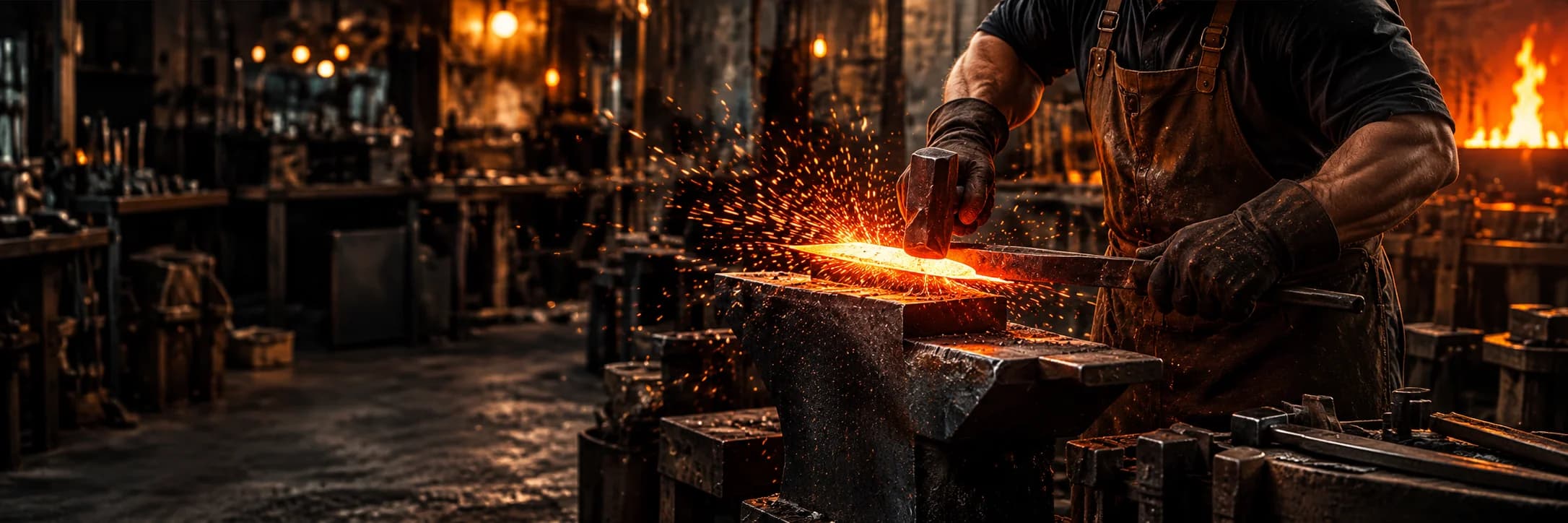
Traditional pattern-welded Damascus production requires careful material selection, controlled forging, finishing, and heat treatment. The precise process varies according to the steels, manufacturing equipment, and desired pattern.
1. Selecting the steel
The process begins with the selection of compatible steel materials.
Some traditional Damascus combinations use steels with different manganese or nickel contents to produce contrasting layers. Other constructions use stainless or higher-alloy materials, including specialized powder-metallurgy Damascus products.
The chosen steels must be compatible with the intended forging and heat-treatment processes. Different alloys respond differently to heat, cooling rates, and subsequent tempering.
Choosing materials solely because they create an attractive contrast can lead to an unsatisfactory result if their processing requirements are poorly matched.
2. Arranging and joining the layers
For conventional pattern welding, pieces of steel are assembled into a stack, often with alternating materials.
The stack is heated to a temperature suitable for forge welding. Under the right conditions, pressure and deformation join the layers into a composite billet.
This is a solid-state joining process: the objective is to bond the steel rather than simply melt the stack into a liquid and cast it.
Achieving sound welds requires control over temperature, surface cleanliness, material compatibility, and forging technique. Poorly bonded regions can become defects in the finished blade.
3. Forging and creating the pattern
The billet is drawn out, twisted, cut, restacked, or manipulated using other forging methods.
These operations change the arrangement of the layers and influence the final pattern. Different techniques create different appearances, including flowing waves, twists, circular motifs, and geometric designs.
The number of layers can vary considerably. Folding and restacking may increase the layer count, but the exact pattern also depends on the steel combination, the way the billet is manipulated, and how much material is removed during grinding.
More layers do not automatically mean a better knife.
4. Shaping and heat treatment
Once the billet has been prepared, the maker shapes the blade and establishes its intended geometry.
The blade then requires suitable heat treatment to develop the desired combination of hardness and toughness. Depending on the steel, this may involve heating to a controlled temperature, quenching, and tempering.
This stage is particularly important because the appropriate treatment depends on the actual materials in the blade. A heat-treatment schedule suitable for one Damascus combination may not be suitable for another.
Experimental work discussed by Knife Steel Nerds on pattern-welded Damascus illustrates why steel compatibility and heat-treatment control matter to the finished material's properties.
5. Grinding, polishing, and etching
After heat treatment, the blade is ground to establish the edge geometry and cutting profile. The surface is then finished and etched where appropriate.
Etching reveals differences in how the constituent materials react to the treatment, producing the familiar contrast between layers.
A well-executed pattern depends on more than attractive etching. The blade also needs sound construction, suitable geometry, and an appropriate heat treatment for its intended use.
What Creates the Damascus Pattern?
The characteristic Damascus appearance comes from differences in the materials and their response to surface finishing.
In modern pattern-welded Damascus, the constituent steels may differ in alloying elements that influence how strongly or weakly they react during etching. These differences create contrasting regions across the blade.
A common misconception is that modern Damascus necessarily has alternating hard and soft layers because the original steels had different carbon contents.
A peer-reviewed study by John D. Verhoeven and Howard F. Clark examined modern pattern-welded Damascus blades and found no hardness differences between the layers they tested. Their research showed that differences in alloying elements, rather than a simple alternating-hardness explanation, accounted for the contrasting etched appearance in the blades studied. Read the 1998 study in Materials Characterization.
This distinction is important: a visible pattern does not, by itself, prove that one part of the blade cuts better than another.
The pattern is evidence of material structure and processing, but performance must be evaluated separately.
Are Damascus Knives Better Than Ordinary Steel Knives?
There is no universal answer. A well-made Damascus knife can perform very well, but Damascus construction alone does not guarantee superior sharpness, toughness, or edge retention.
A comparison is most useful when it considers the complete knife rather than its appearance.
Factor
What matters in practice
Sharpness
The edge geometry, sharpening quality, and condition of the cutting edge
Edge retention
Steel composition, heat treatment, hardness, cutting conditions, and blade geometry
Toughness
Material properties, heat treatment, geometry, and the type of stress encountered
Corrosion resistance
Alloy composition, processing, surface condition, and maintenance
Appearance
Pattern formation, etching, polishing, and the maker's finishing work
Durability
Material quality, sound construction, suitable design, and proper use
A single-alloy steel knife can offer excellent cutting performance without a patterned blade. A Damascus knife can offer comparable performance while also providing a distinctive appearance, provided its materials and manufacture are appropriate for the job.
Conversely, a Damascus blade with unsuitable materials or poor heat treatment may perform worse than a well-made knife using a conventional steel.
For further technical context, Knife Steel Nerds' testing of powder-metallurgy Damascus discusses how the properties of the component steels and the heat treatment influence results. Such testing applies to the specific materials and conditions examined; it should not be interpreted as a guarantee for every Damascus knife.
Types of Damascus Knives and Steel Constructions
Not every knife described as Damascus uses the same material system. Understanding the main differences makes it easier to assess a product.
Pattern-welded carbon-steel Damascus
This construction uses joined layers of steel, often selected to produce contrasting patterns after etching.
Depending on the materials and treatment, a carbon-steel Damascus blade can provide useful cutting performance and an attractive finish. However, it may be more susceptible to corrosion than a suitably formulated stainless-steel blade.
It generally benefits from prompt cleaning, thorough drying, and appropriate storage.
Pattern-welded stainless Damascus
Stainless Damascus constructions use materials chosen to create a patterned appearance while providing corrosion resistance.
However, the term stainless Damascus should not be accepted as a complete material specification. The actual alloys, construction, and heat treatment still matter.
A steel's stainless classification does not mean it is immune to corrosion under every condition. Salt, moisture, acidic substances, surface damage, and neglected cleaning can all affect corrosion behaviour.
As an example of why material specifications matter, Alleima's 14C28N technical datasheet explains how alloy composition and heat-treatment conditions affect hardness, wear resistance, toughness, and corrosion resistance. It describes a specific knife steel, not every Damascus construction.
Powder-metallurgy Damascus
Some modern patterned steels are produced through specialized processes that differ from conventional stacking and forge welding. Powder-metallurgy Damascus is one example.
Such products can combine carefully selected materials with controlled manufacturing. Their performance still depends on the specific steel system and processing parameters rather than the label alone.
Damascus-style surface patterns
Some blades feature a decorative pattern applied or etched onto a single steel rather than a true pattern-welded composite.
A decorative surface pattern is not necessarily evidence that the knife is unusable or poorly made. The important point is to understand what is being purchased.
Buyers who specifically want layered Damascus should confirm the construction and constituent materials instead of relying exclusively on product photographs.
How to Choose a Damascus Knife
The best choice depends on what the knife will be used for, how it is constructed, and how much maintenance its owner is willing to perform.
Start with the intended use
A chef's knife, hunting knife, outdoor knife, and collectible knife have different design requirements.
For kitchen work, consider the blade profile, edge geometry, balance, handle comfort, cleaning requirements, and suitability for food preparation.
For outdoor use, consider the intended cutting tasks, grip, blade design, corrosion exposure, and safe handling. Do not assume that a decorative or collectible design is suitable for heavy-duty work.
Ask about the steel
A seller's description should explain the material construction as clearly as possible.
Useful questions include:
Which steel grades or material system are used?
Is the blade pattern-welded, powder-metallurgy Damascus, or a decorative surface treatment?
What heat treatment is used for the specific construction?
Is the blade stainless or non-stainless, and what maintenance does the maker recommend?
A specific answer is more useful than a general claim that the knife is made from premium Damascus steel.
Consider the blade geometry and finishing
Steel composition is only one part of cutting performance.
The blade's thickness, grind, edge angle, finish, and overall design influence how it cuts and how it responds to different tasks. A well-finished blade designed for a specific application may be more suitable than a visually elaborate blade with inappropriate geometry.
Evaluate the maker's manufacturing quality
Look for clear information about material selection, forging or construction, heat treatment, grinding, finishing, and inspection.
For custom and wholesale orders, it is also sensible to confirm specifications, dimensions, branding requirements, sample approvals where applicable, and the intended use before approving production.
How to Care for Damascus Steel Knives
Care requirements depend on the steel construction. Many Damascus knives, particularly those made with non-stainless steels, benefit from more attentive moisture management than corrosion-resistant stainless knives.
Clean and dry the blade promptly
After use, clean the blade using an appropriate method, then dry it thoroughly. Avoid leaving it wet or soaking it for extended periods.
For kitchen knives, acidic foods and salty residues can encourage surface changes or corrosion, especially on non-stainless steel. Clean the blade after contact with these materials.
Avoid the dishwasher
Unless the maker explicitly specifies otherwise, handwashing is the safer approach for quality knives.
Dishwashers expose knives to heat, detergents, prolonged moisture, and possible contact with other objects. These conditions can damage the blade's finish and may harm handles or other components.
Use suitable protection when storing
For non-stainless blades, a thin coating of food-safe mineral oil can help protect a clean, dry blade during storage when appropriate for the product and its intended use.
Follow the manufacturer's guidance, particularly for knives used in food preparation. Use only suitable products on food-contact surfaces.
Store knives in a dry location. Avoid putting a damp blade into a sheath or enclosed storage space, where trapped moisture may increase corrosion risk.
Use the knife for its intended purpose
Even a well-made blade can suffer damage when used incorrectly. Use a suitable cutting surface, and avoid twisting, prying, or applying forces the knife was not designed to withstand.
For kitchen knives, wood or suitable plastic cutting boards are generally preferable to hard surfaces such as glass or stone, which can damage the edge.
Regular maintenance, appropriate sharpening, and proper storage help preserve both function and appearance.
Damascus Steel: Safety and Responsible Use
Damascus steel does not remove the ordinary risks associated with sharp blades.
Handle knives carefully, cut away from your body when practical, maintain a secure grip, and keep the blade under control during use. Store knives securely and out of reach of children.
When purchasing a knife for a particular activity, make sure the design is appropriate for that use and follow applicable laws and transport requirements. Decorative appearance should never substitute for suitable design, safe handling, or responsible storage.
Damascus Knives for Custom and Wholesale Projects
For businesses and buyers developing a product range, choosing a Damascus knife involves more than selecting a pattern.
Material construction, blade design, dimensions, handle materials, finishing, packaging, and intended use all need to be considered together. Clear specifications help ensure that the finished product meets the buyer's expectations.
JEXMOO Enterprises is a manufacturer of custom handmade Damascus knives and other forged products, serving individual buyers, wholesale clients, and private-label partners.
Its product collection includes examples of Damascus knives and other custom products. Buyers planning a specific design can discuss requirements such as blade style, dimensions, material preferences, handle options, and branding.
For manufacturing enquiries, the manufacturing page outlines the production process, while the wholesale and B2B page provides information for businesses considering bulk or private-label projects.
Before placing an order, buyers should confirm the precise steel construction, heat-treatment approach, care requirements, dimensions, quantities, and other specifications for the particular product. These details should not be assumed from the appearance of a Damascus pattern alone.
Frequently Asked Questions
Is Damascus steel real steel?
Yes. Genuine pattern-welded Damascus is a composite made by joining steel materials. Specialized patterned steel constructions also exist. However, some products use decorative surface patterns rather than layered Damascus, so buyers should confirm the construction.
Is Damascus steel stronger than regular steel?
Not automatically. Strength, toughness, edge retention, and other properties depend on the materials, heat treatment, geometry, and manufacturing quality. A Damascus pattern alone does not establish superiority over a single-alloy steel.
Does Damascus steel rust?
It can. Corrosion resistance depends on the actual steel composition and construction. Non-stainless Damascus may require especially careful drying and storage, while stainless constructions can also corrode under certain conditions.
Do more layers make a better Damascus knife?
No. Layer count is primarily one part of the construction and pattern-making process. It does not independently determine sharpness, toughness, edge retention, or overall quality.
Are Damascus knives suitable for everyday use?
They can be, provided the specific knife is designed for the task. Consider blade geometry, material properties, handle design, and maintenance requirements before choosing one for regular kitchen or outdoor use.
Conclusion
Damascus steel combines material engineering with a distinctive patterned appearance, but its appeal should be understood alongside the practical requirements of a good knife.
Historical crucible Damascus and modern pattern-welded steel are different constructions. Within modern Damascus knives, steel composition, manufacturing technique, heat treatment, blade geometry, and maintenance all influence the final result.
A patterned blade is not automatically stronger, sharper, or more durable than a conventional steel blade. The right choice depends on the intended use, the quality of the finished knife, and the owner's care routine.
For buyers exploring custom Damascus knives, the most useful next step is to evaluate the specific construction and product requirements—not just the pattern.